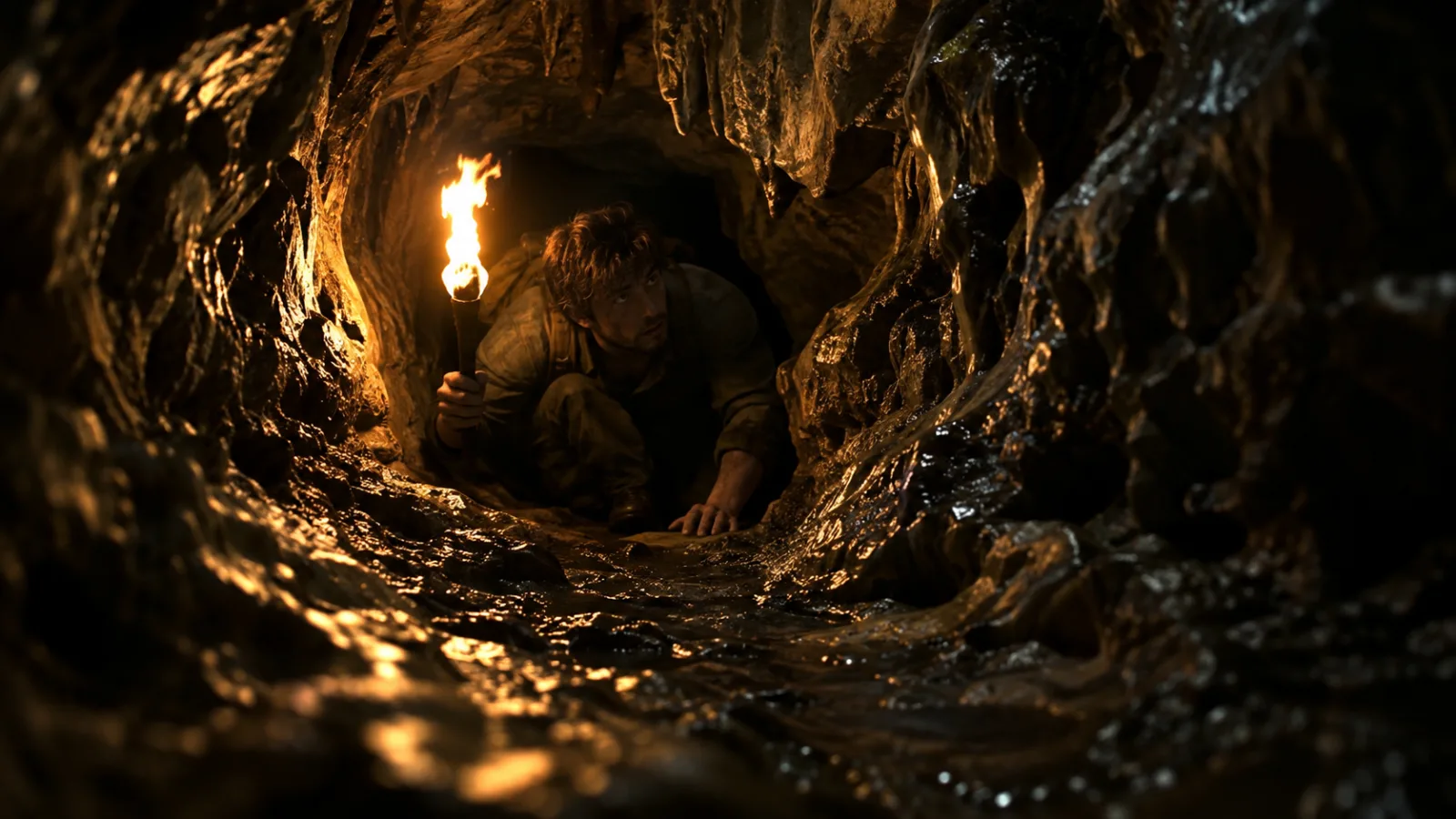
Six hundred feet inside a cave in southern France, past a passage so narrow a person has to crouch and twist sideways to get through, past the point where all natural light disappears, someone built two structures out of broken stalagmites. Not near the entrance. Not close enough to catch a stray beam of sun. Deep in the permanent dark, in a chamber where the temperature never changes and the silence has a kind of weight, someone carried fire in, and stone, and purpose.
That was about 176,000 years ago. It was long before the paintings at Lascaux, long before Stonehenge, and long, long before the pyramids. And the species that did it wasn't us. It was Neanderthals.
The question that has followed this discovery since it was first announced is disarmingly simple: why would anyone go that deep into the dark, at that point in human history, to build something?
This is Bruniquel Cave, in the Aveyron department of southern France, and it may be the oldest known constructed structure on Earth.
What We Used to Believe About Neanderthals
To understand why this matters, you have to understand what people believed about Neanderthals before this cave gave up its secret.
Neanderthals were a distinct human species that lived across Europe and parts of western Asia for several hundred thousand years, disappearing from the fossil record around 40,000 years ago. For most of the twentieth century, the popular image of them was blunt and unflattering: hunched, brutish, driven by instinct rather than thought. Capable of survival, perhaps, but not of culture, not of art, and not of anything we would recognize as deliberate, symbolic behavior.
That picture has been eroding for decades. Researchers have found evidence that Neanderthals buried their dead, used pigments, made jewelry from eagle talons, and crafted tools with real sophistication.
The Last Boundary: Deep Caves
Even as that picture softened, one boundary held firm in most scientists' minds. Deep caves, the kind that demand sustained darkness and real risk to enter, were considered the domain of a later human achievement. Modern humans, *Homo sapiens*, painting bison and horses by torchlight in chambers like Lascaux and Chauvet, tens of thousands of years ago. Neanderthals, went the assumption, simply didn't go there. They didn't have the cognitive architecture for it. Deep cave use was supposed to be a marker of the modern human mind.
Bruniquel Cave broke that assumption, and it broke it by a margin so large that the team behind the dating results had to check their work more than once before they believed it themselves.

Inside Bruniquel Cave
The cave had been known since the 1990s, when a local explorer first pushed through the entrance passage and mapped its interior. But it took years of specialized work, led by French researcher Jacques Jaubert and an interdisciplinary team, to properly understand what was sitting inside it.
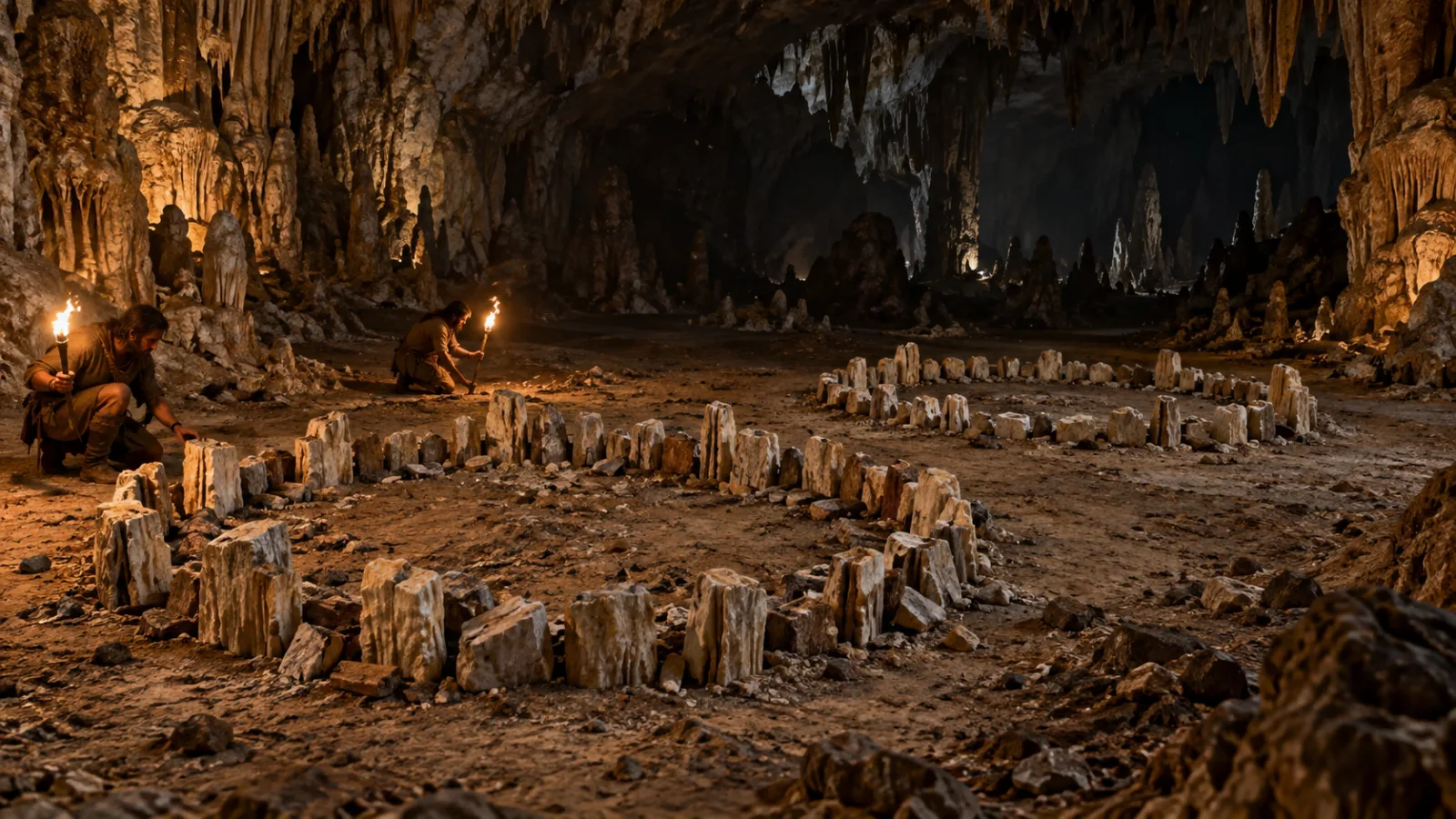
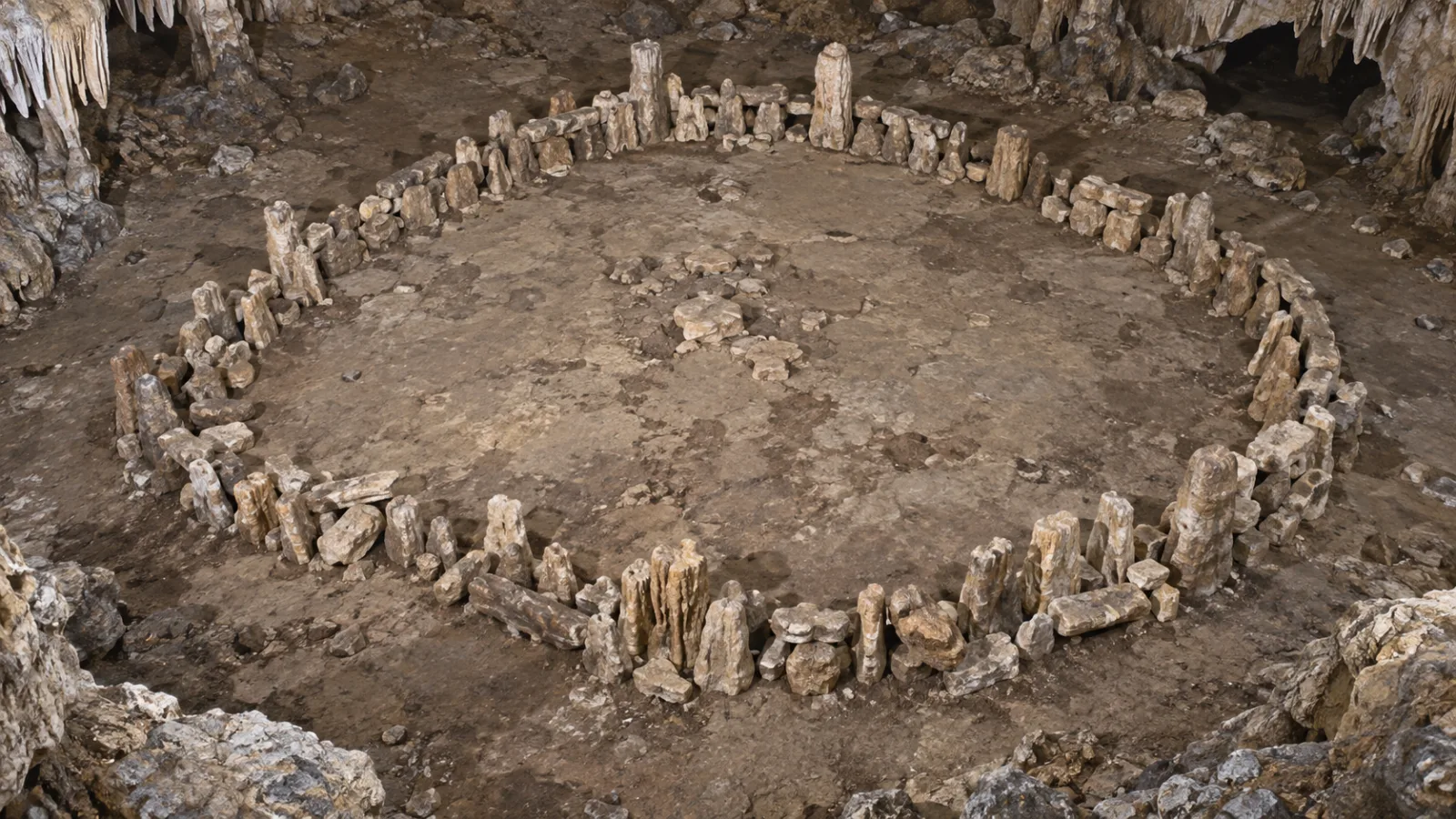
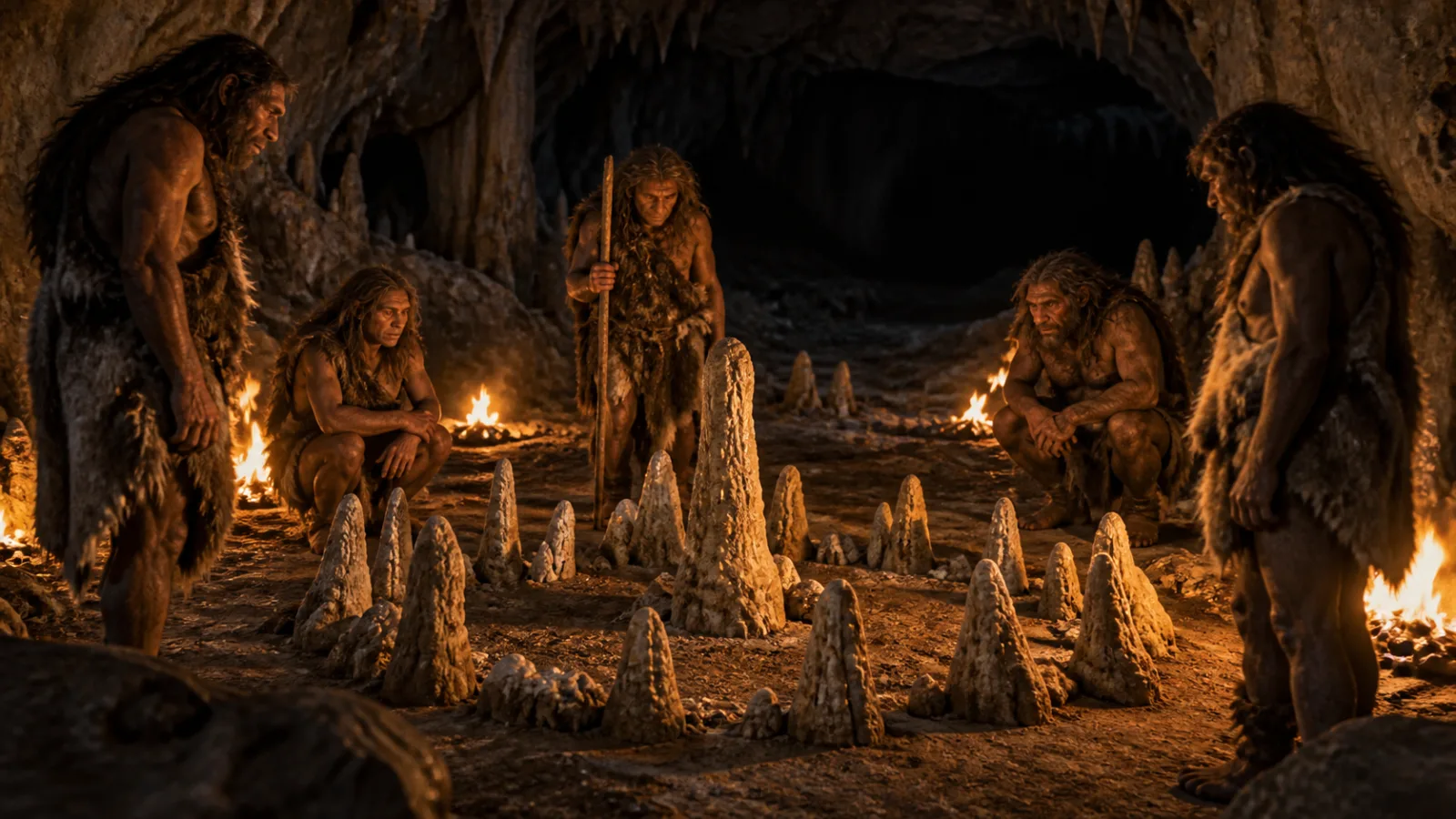
Deep within the cave, in a chamber reached only after a long, low crawl through darkness, the team found something that stopped them cold: hundreds of stalagmites, broken off near their bases and arranged deliberately into two structures.
- One structure is roughly oval, made of stacked and layered stalagmite fragments forming a low ring about six meters across at its widest point.
- Four smaller, similar piles sit nearby.
- More broken stalagmite pieces are scattered among the structures, laid out with a regularity that doesn't look accidental.
Evidence of Fire
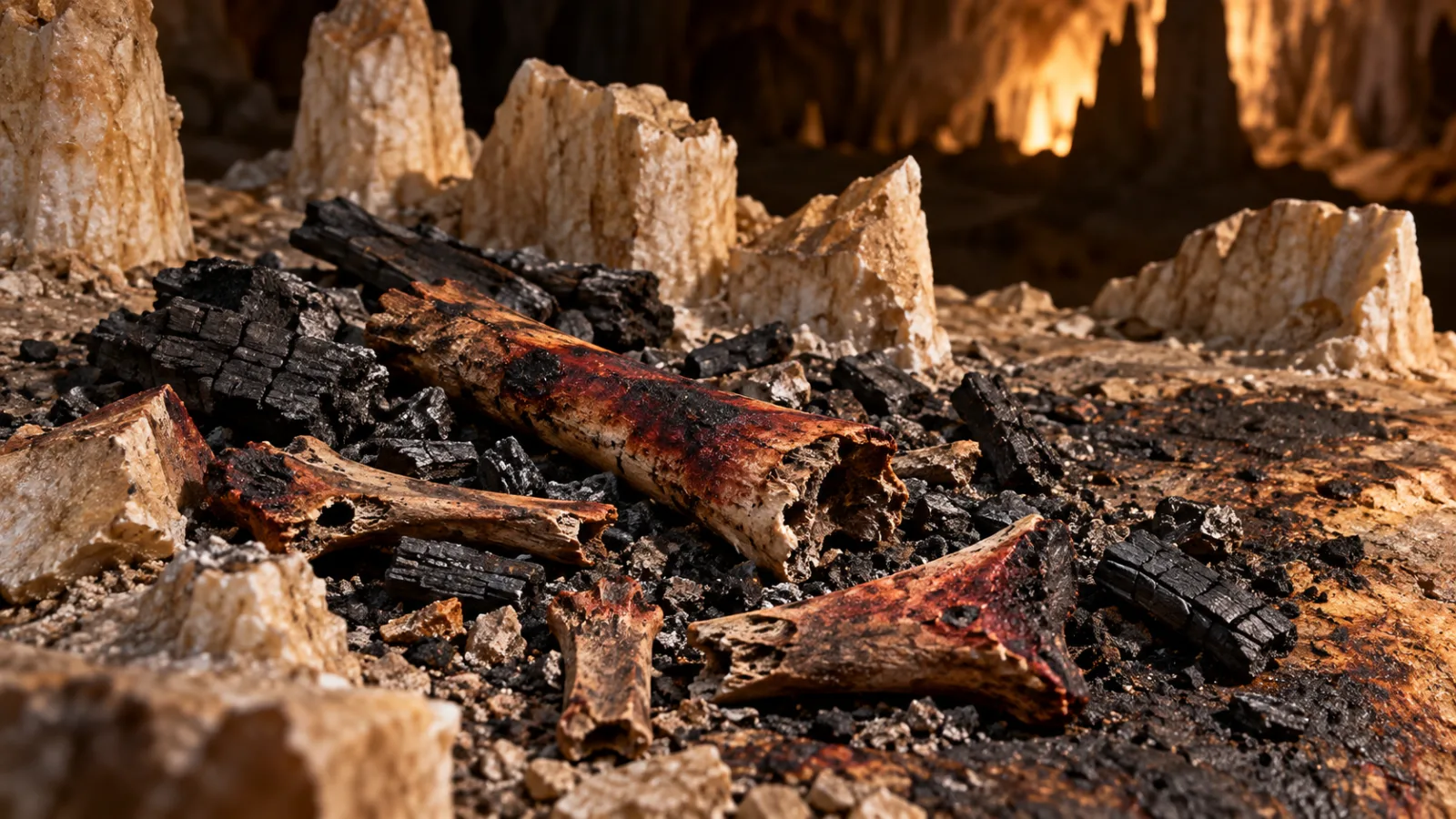
There is fire, too. Burned and reddened bone fragments were found within the structure, along with charcoal and traces of fire damage on some of the stalagmite material itself. Whoever built this didn't just enter the chamber once and leave. They brought flame into a space some 600 meters from daylight, and they used it there.
How Scientists Dated the Structures
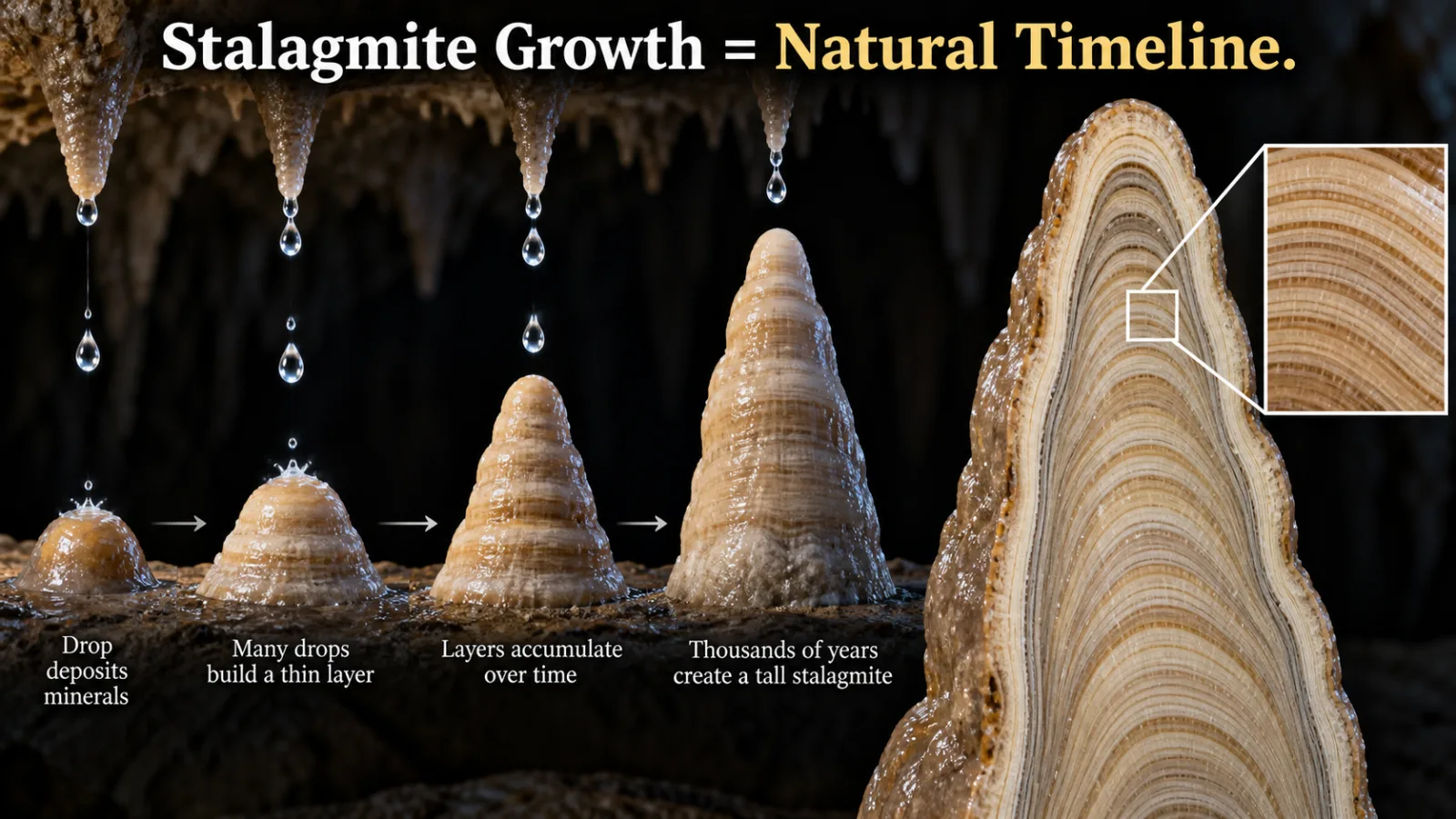
The stalagmites themselves are the key to the mystery, because they can be dated. Stalagmites grow from mineral-rich water dripping onto a cave floor over vast stretches of time, adding microscopic layers the way a tree adds rings. When a stalagmite is broken, its growth stops at the break, and if new mineral deposits form on the broken surface afterward, that regrowth can be measured using a technique called uranium-thorium dating.
The team collected samples from the broken stalagmites within the structures and dated both the original growth and the regrowth on the broken ends. If the structures were built recently, or even by early modern humans tens of thousands of years ago, the numbers would fall well within that range. They didn't.
A Result That Rewrote the Timeline
The dating, published in 2016 in the journal *Nature*, placed the construction of the structures at approximately 176,500 years ago. Multiple samples, taken from different stalagmite fragments within both structures, converged on essentially the same age. That consistency is what gave the researchers confidence. This wasn't one anomalous sample. It was a pattern repeated across the site.
At that time, modern humans hadn't yet arrived in Europe. The region was occupied exclusively by Neanderthals, and there is no reasonable candidate for who built the structures except them.
What It Took to Build Them
Consider what the construction actually required. The chamber sits roughly 330 meters from what would have been the cave's entrance in that era; geologists believe the original opening has since collapsed or shifted. The deep chamber is reached after winding, low passages that demand crouching and careful movement even today.
Anyone going in needed a reliable light source: torches, most likely, or fat-fueled lamps, something that could survive the trip and still be burning on arrival. They needed to know the route well enough to navigate it without daylight, and to get back out again. Once inside, they broke off close to 400 stalagmite fragments, with some estimates putting the total mass of the arranged material at several hundred kilograms, and arranged them with evident intention.
This was not a one-time accident of a group wandering in and stacking a few rocks. It was a planned, resourced, repeated undertaking, deep inside a cave, carried out by a species many scientists had assumed lacked the cognitive tools for exactly this kind of behavior.

So What Were They Doing Down There?
No one knows, and the researchers themselves say so plainly. The structures don't resemble tools, weapons, or anything with an obvious practical function. There is no evidence of habitation, no discarded food remains or signs that anyone lived in the chamber for any real length of time. Whatever happened here appears to have been a visit, not a residence.
The Ritual or Symbolic Idea
One leading idea is that the structures served some kind of symbolic or ritual purpose. Deep, dark, silent spaces have carried spiritual and ceremonial weight across an enormous range of later human cultures. Some researchers suggest that the deliberate use of fire in a chamber, with no practical need for it beyond the visit itself, hints at behavior connected to belief, memory, or shared meaning: something built to mark or commemorate rather than to serve a physical need.
A Case for Caution
Others urge caution against reaching for the word "ritual" too quickly. The structures may have had a more mundane function that simply doesn't survive in the archaeological record:
- A gathering point.
- A marker used for orientation deep underground.
- A form of shelter tied to some seasonal or environmental use of the cave that we don't yet understand.
The honest scientific position is that intention is visible in the physical evidence. The reason behind that intention is not.
What It Says About the Neanderthal Mind
The discovery also raises a deeper question about Neanderthals themselves. Building something in total, permanent darkness, far from any natural light and any practical daily use, suggests a group capable of long-term planning. It implies spatial memory sophisticated enough to navigate hundreds of meters of cave passage without getting lost, and very likely some form of social organization that allowed knowledge of the site, and perhaps its purpose, to be shared or passed along.
Whether that also implies the kind of symbolic thought once considered uniquely modern is something the physical evidence alone can't answer. It only tells us that they were capable of far more than most models of Neanderthal life had allowed for.
Scrutiny of the Dating
The dating hasn't gone unchallenged. Uranium-thorium dating on cave formations is a well-established technique, but some researchers have raised questions about whether contamination or complex growth histories in the stalagmites could affect the ages obtained. The original team addressed several of these concerns directly in their published work, and the broad scientific consensus has largely accepted the results. Even so, Bruniquel remains a site where every claim invites scrutiny, precisely because of how much rides on the numbers being right.
The Mystery That Remains
That is really what makes this place so unsettling to sit with. Everything else in the story, the stalagmites, the fire traces, the layout of the chamber, is physical and measurable. It's the *why* that refuses to resolve. A species once imagined as barely capable of surviving the day pushed itself, deliberately and repeatedly, into absolute darkness, carried fire past the point where daylight could ever reach it, and built something there for a reason it never explained and never wrote down.
Somewhere in that chamber, in the arrangement of stone no living person witnessed being placed, there is a decision that was made 176,000 years ago and has not been found repeated anywhere else. What it meant to the people who made it may be the one thing about them we will never recover.