The rain started somewhere over Oregon.
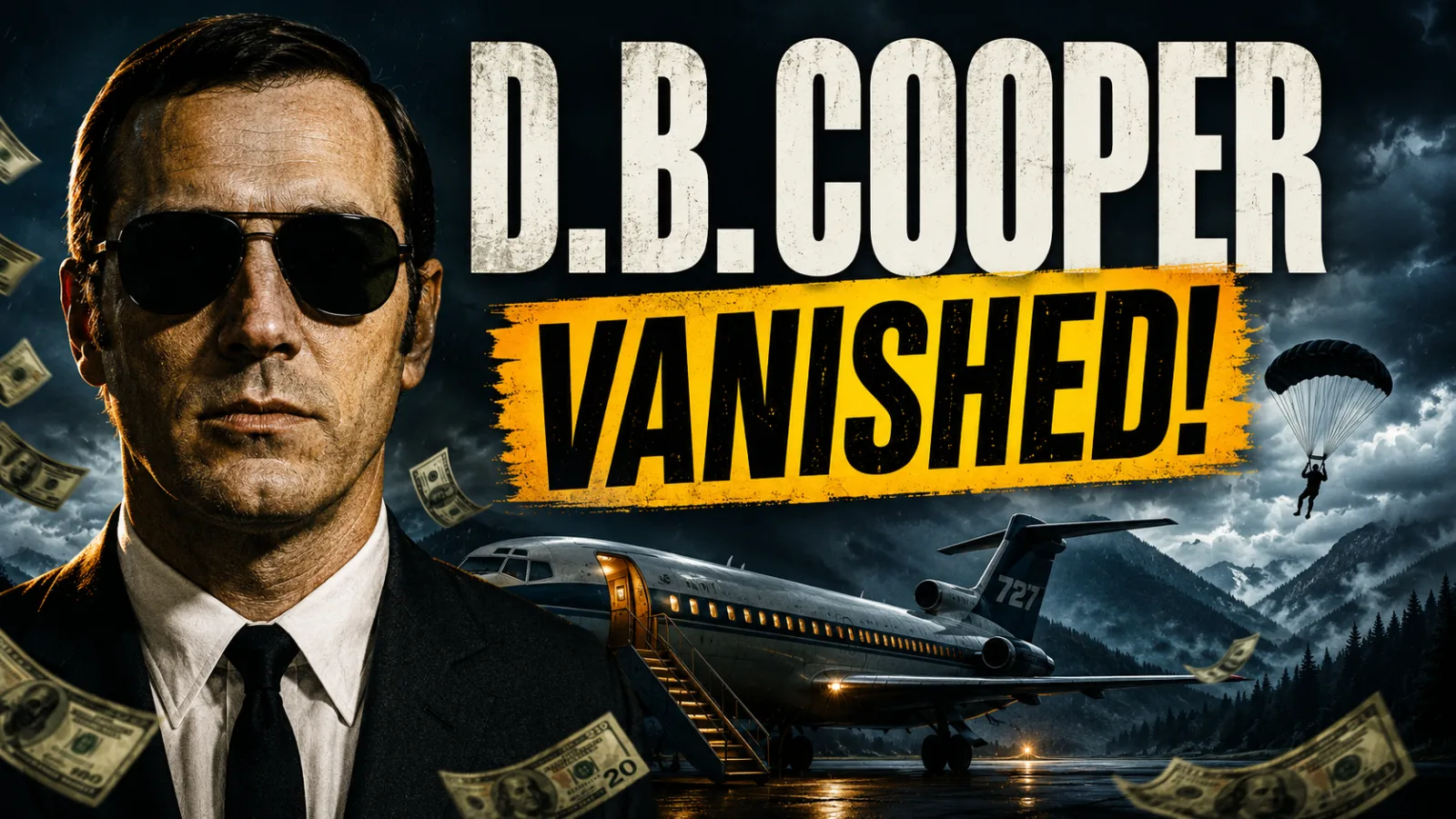
Inside the cabin of a Boeing 727, a man in a dark suit and sunglasses sat quietly with a briefcase on his lap. He had ordered a bourbon and soda and paid for it. Outside the window, the sky was the color of wet slate, and below, the forests of the Pacific Northwest rolled out in an unbroken carpet of green.
Sometime after eight o'clock in the evening on November 24, 1971, that man lowered the plane's rear staircase into the freezing night air, stepped out into the darkness above the Cascade Mountains, and was never seen again.
He had $200,000 in ransom money strapped to his body, a parachute, and a name that wasn't really his own. The FBI would spend forty-five years chasing him — questioning suspects, digging through riverbanks, analyzing scraps of evidence — before closing the most extensive unsolved hijacking case in the Bureau's history without ever learning who he was.
This is the story of D.B. Cooper.
A Golden Age for Skyjacking
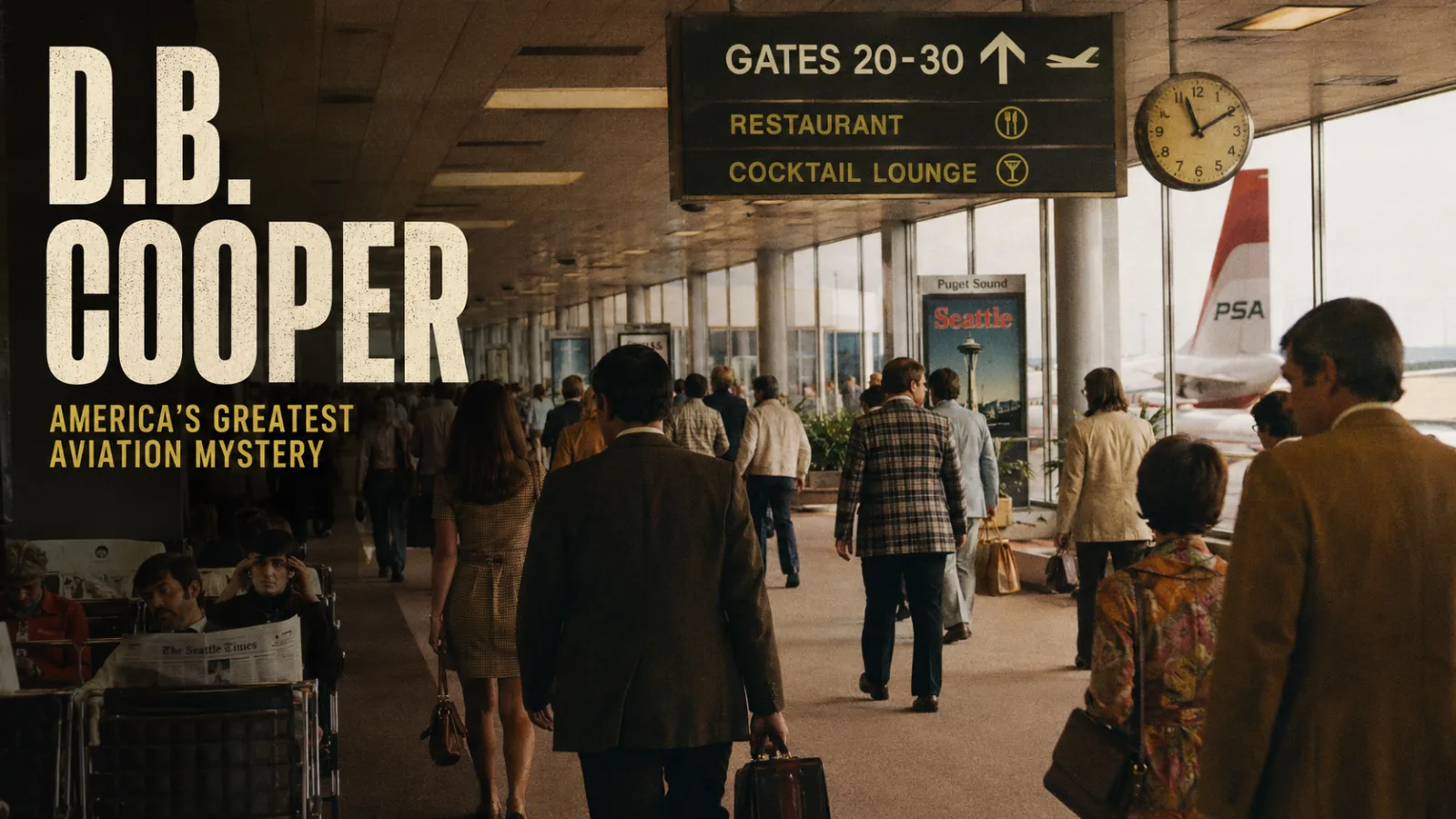
To understand how a man could disappear so completely, it helps to understand what commercial air travel looked like in America at the start of the 1970s. Security, by today's standards, was almost nonexistent. There were no widespread passenger screenings and no metal detectors at most gates. Tickets could be bought with cash under any name, and passengers walked straight onto planes.
Between 1968 and 1972, the United States experienced a wave of airline hijackings so frequent that some crews carried extra cash on board specifically to pay off hijackers and end incidents quickly. It was, in effect, a golden age for skyjacking — and on the day before Thanksgiving 1971, one man was about to make it infamous.
The Man Who Boarded Flight 305
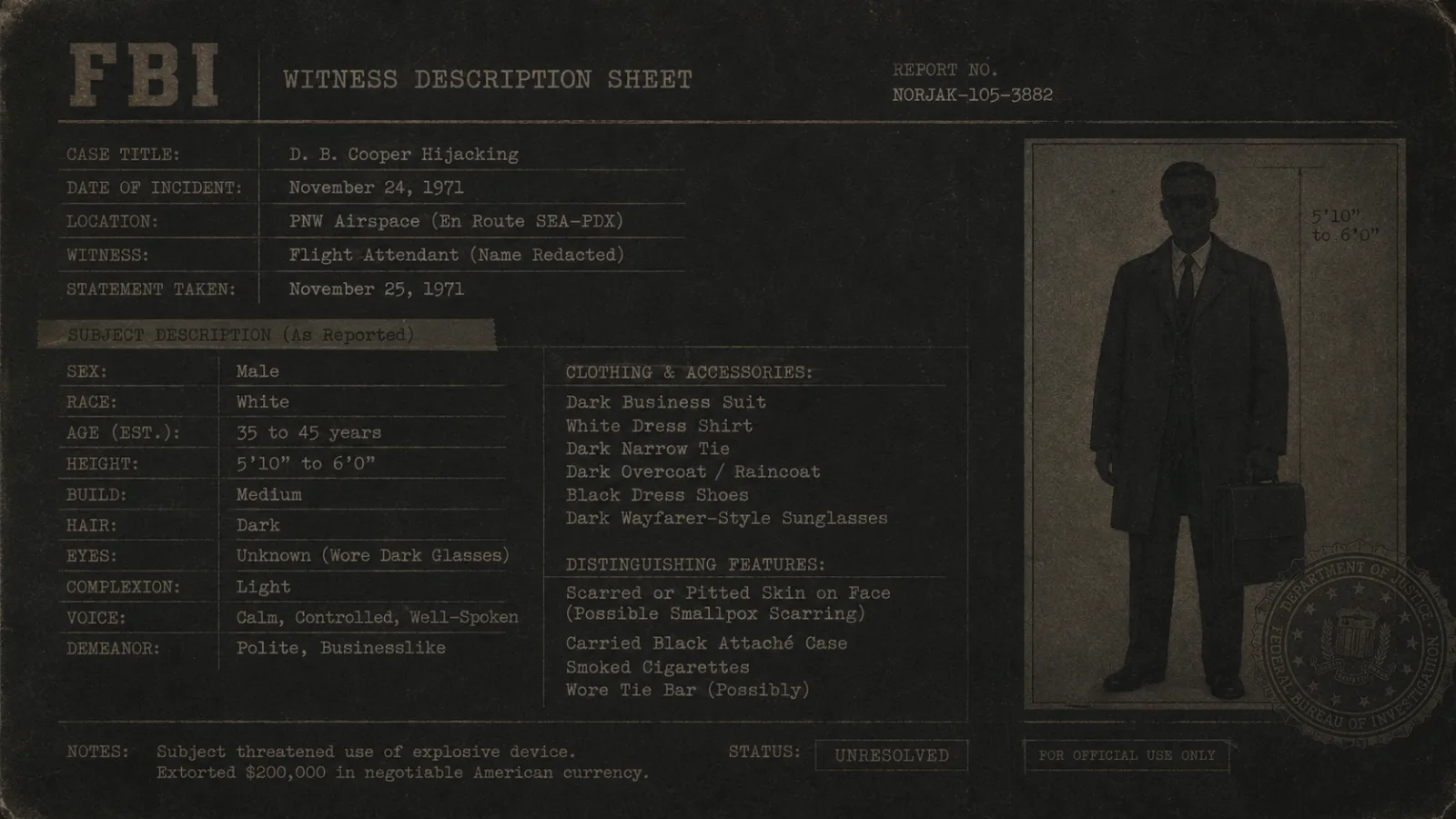
At Portland International Airport, a passenger approached the Northwest Orient Airlines counter and bought a one-way ticket to Seattle for twenty dollars in cash. He gave his name as Dan Cooper. Witnesses described him as a man in his mid-forties, about five foot ten, wearing a black raincoat, dark suit, white shirt, and black tie, carrying a briefcase.
He boarded Northwest Orient Flight 305 without incident, took seat 18-C near the rear of the plane, lit a cigarette, and ordered a drink. Nothing about him suggested anything unusual — until he handed flight attendant Florence Schaffner a folded note.
Schaffner assumed it was a phone number and slipped it into her pocket unread. Cooper leaned over and told her she'd better look at it. He said he had a bomb in his briefcase.
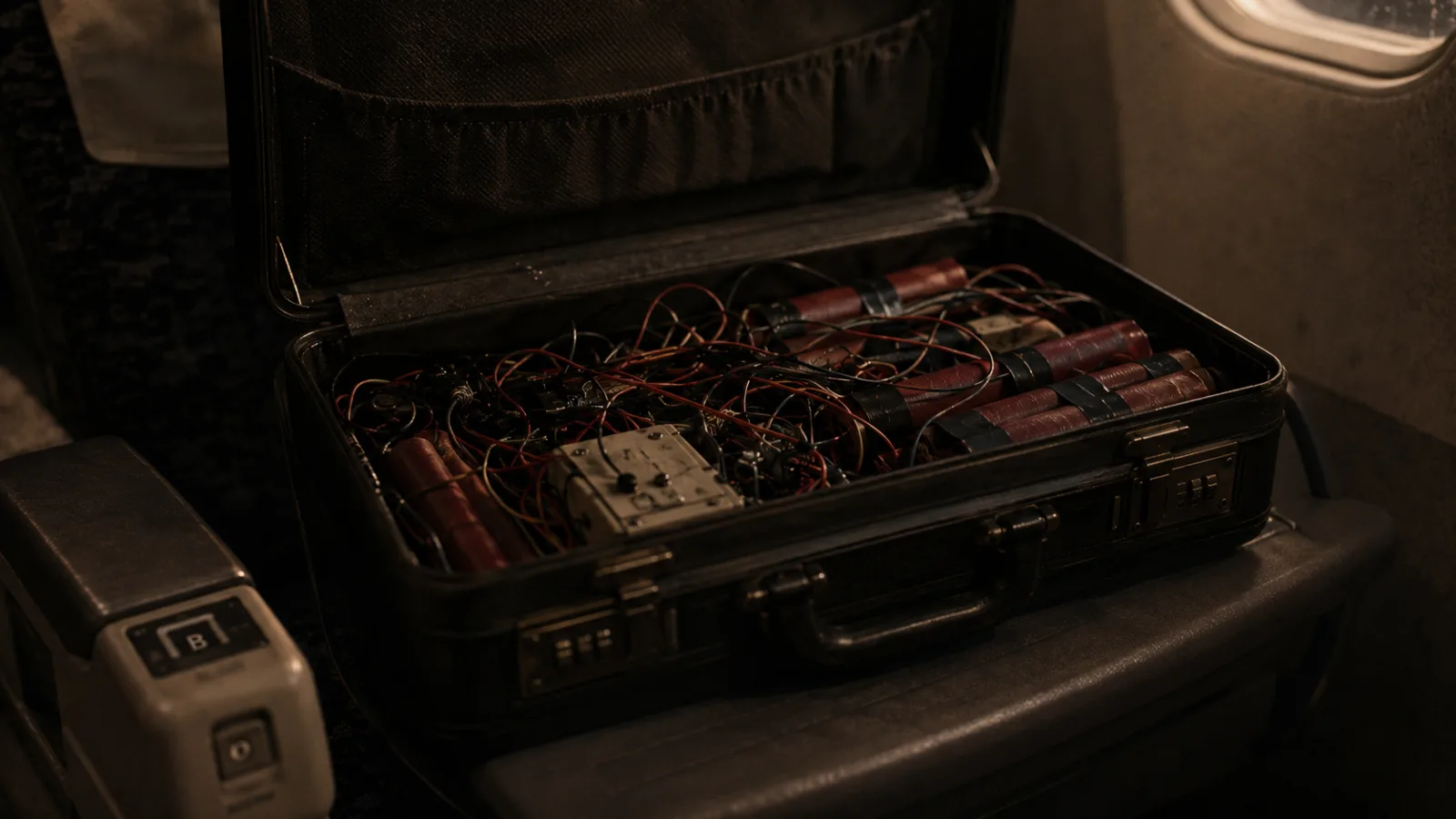
When Schaffner read the note, Cooper opened the briefcase just enough to show her a tangle of wires and red cylinders. Whether the device was real has never been confirmed, but it looked convincing enough that no one was willing to test it.
Ransom Demands and a Waiting Game
Cooper's demands were specific and almost businesslike: $200,000 in unmarked twenty-dollar bills, four parachutes — two primary and two reserve — and a fully refueled plane ready to continue flying once it landed, with all passengers released unharmed.
Northwest Orient's president authorized the payment personally. While the plane circled Seattle for nearly two hours awaiting the money and parachutes, passengers were told only that there was a minor mechanical delay. Most had no idea a hijacking was underway until it was over.
When the plane landed at Seattle-Tacoma Airport, Cooper released the thirty-six passengers and two flight attendants, keeping only the cockpit crew. He inspected the parachutes closely enough to reject one as unsuitable, then gave his final instructions: the plane would fly on toward Mexico City, staying below ten thousand feet, with flaps set at a specific angle, landing gear down, and the cabin unpressurized — an unusual configuration suggesting real aviation knowledge.
The Jump Into the Storm
Somewhere over the dense, roadless wilderness of southwest Washington, in pouring rain and near-total darkness, Cooper lowered the aft staircase of the 727 — a rare feature of that aircraft — and stepped out into the night.
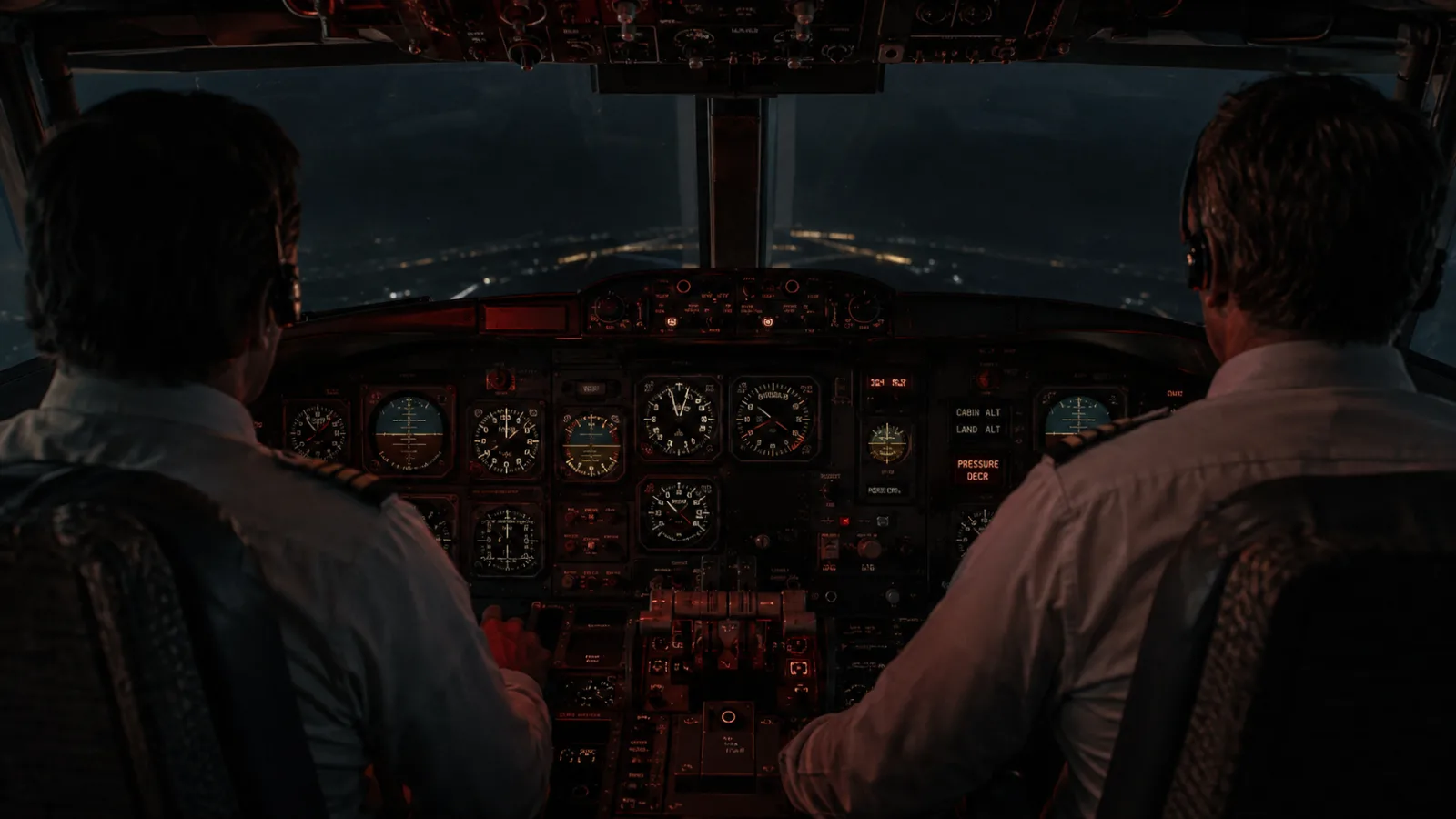
The crew, still in the cockpit, felt the pressure change but never saw him go. No one did. When the plane landed in Reno, Nevada, Cooper was gone. So was the money.
How D.B. Cooper Got His Name
A journalist covering the story introduced an error that became legend, referring to the hijacker as D.B. Cooper instead of Dan Cooper — likely a mix-up with a different person questioned early in the investigation. The mistake stuck permanently, and the country came to know him by an initial that was never even accurate.
The FBI's Forty-Five-Year Hunt
The FBI's investigation, code-named NORJAK, became one of the longest-running cases in the Bureau's history. Agents interviewed everyone connected to the flight, pulled fingerprints from the plane and the discarded drink glass, and compiled a list of more than eight hundred suspects.
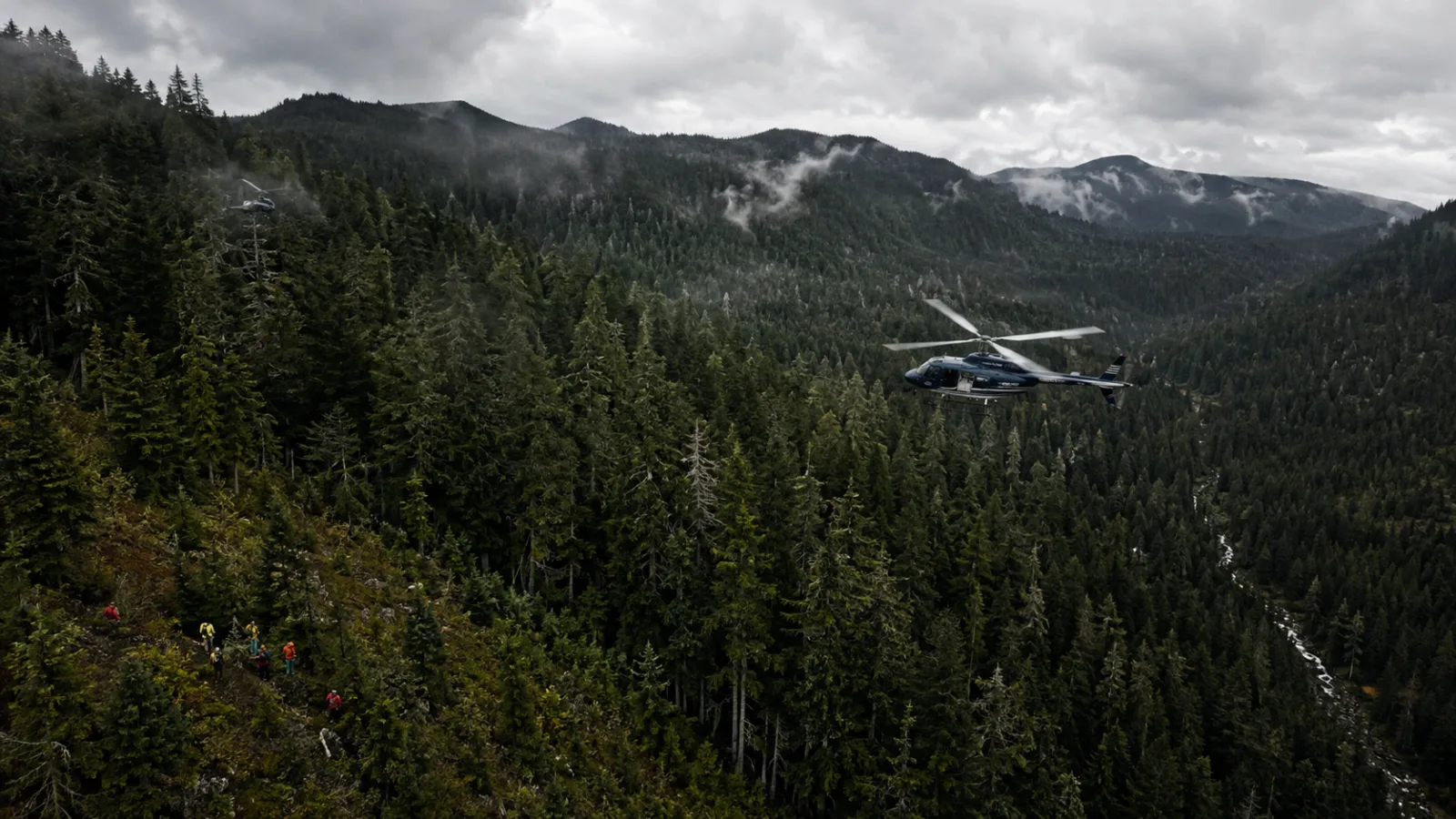
Ground teams and aircraft searched the forests of southwest Washington for weeks. The terrain was some of the most unforgiving in the country — thick timber, steep ravines, freezing rain — and Cooper had jumped at night, in a business suit and loafers, with no confirmed skydiving experience.
For years, nothing surfaced.
The Money Resurfaces
In February 1980, an eight-year-old boy named Brian Ingram was digging in the sand along the Columbia River near Vancouver, Washington, when he found decaying packets of cash. FBI analysis confirmed the serial numbers matched the ransom bills — roughly $5,800 of the original $200,000, the only portion ever recovered.
The find deepened the mystery. If Cooper died in or shortly after the jump, how had the money traveled some twenty miles from the presumed jump zone to that sandbar? Geologists and hydrologists have studied the river's flow and dredging history, and the leading theory holds that natural sediment movement or dredging operations carried the cash there rather than Cooper himself. It remains a theory, not a confirmed explanation.

The Suspects Who Were Never Confirmed
Over the decades, investigators examined numerous possible identities for Cooper:
- Richard McCoy Jr., a Vietnam veteran and trained parachutist who carried out a strikingly similar hijacking five months later, but was ultimately ruled out by physical description and other evidence.
- Kenneth Christiansen, a former paratrooper and Northwest Orient employee, drew suspicion after his death due to similarities in age and appearance, though no direct evidence tied him to the crime.
- Duane Weber, who told his wife on his deathbed that he was "Dan Cooper," but left no conclusive forensic link.
- Robert Rackstraw, a Vietnam veteran publicly named by independent researchers, though the FBI stated the evidence did not support charging him.
None of these leads produced a conviction or a confirmed identity.
A Case Closed Without an Answer
In July 2016, the FBI formally suspended active investigation into the case, citing limited resources and the absence of new evidence, though it said it would still review material submitted by the public. After forty-five years, the Bureau closed its most exhaustive unsolved hijacking case without a name, a body, or a confirmed conclusion.
What the Evidence Does — and Doesn't — Show
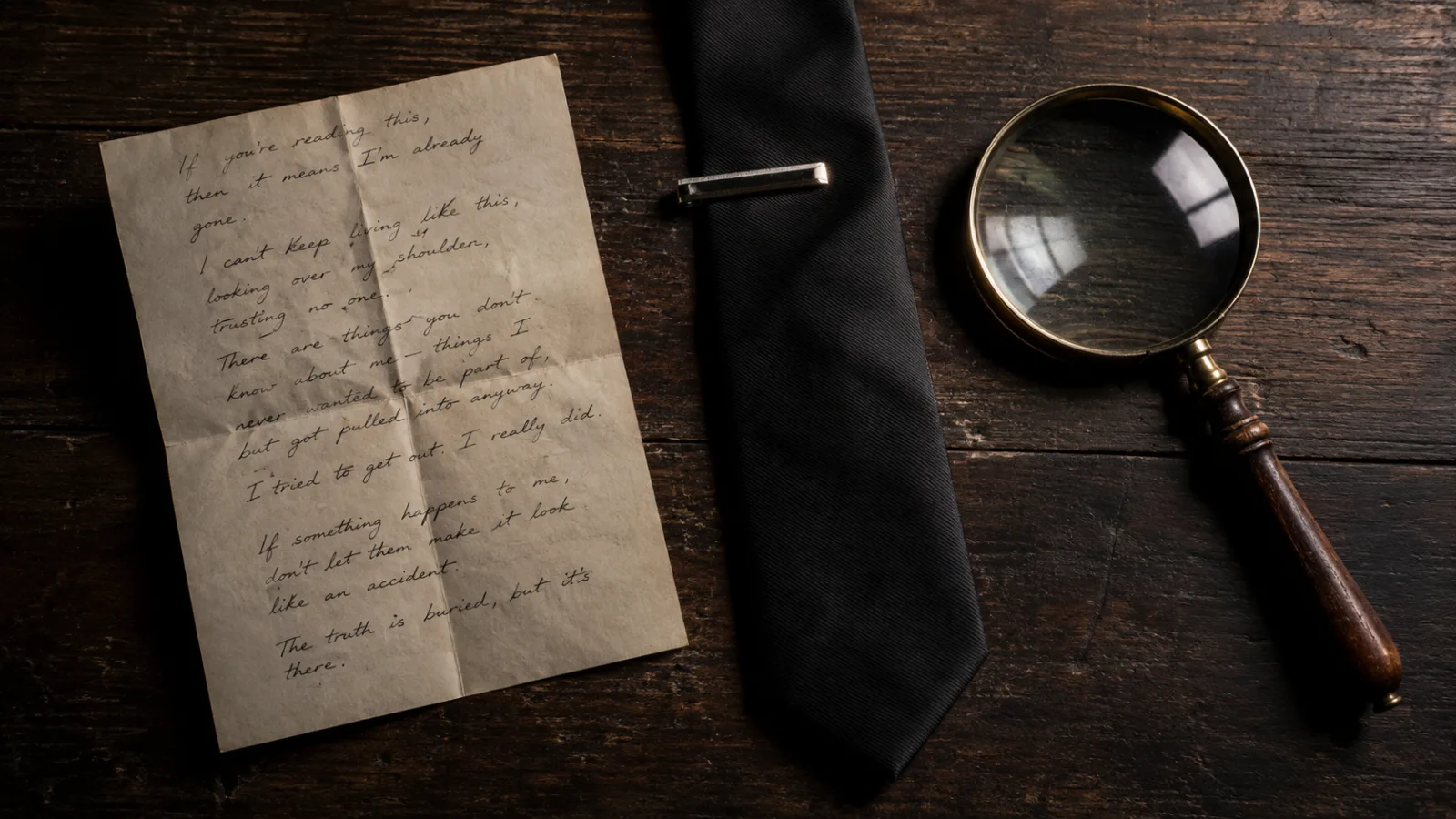
The physical evidence that survives is sparse but suggestive. The ransom note. The black clip-on tie Cooper left in his seat, which decades later yielded traces of rare earth elements sometimes linked to metallurgical or electronics manufacturing — hinting, but not proving, that he may have worked in an industrial or technical field. The recovered cash. And the parachute he chose not to use, which some skydivers argue shows specific knowledge of parachute types, since he left an older military-style chute behind in favor of another.
Three Theories, No Resolution
Explanations for Cooper's fate generally fall into three camps.
The first holds that he did not survive the jump. Experts have long argued that jumping at night, in poor weather, over mountainous forest, in street clothes and dress shoes, made survival unlikely — and that his body and most of the money were simply never found in such remote terrain.
The second holds that he survived the jump itself but died or disappeared in the wilderness shortly after, his remains never recovered in country that has swallowed even experienced searchers.
The third — the theory that keeps the case alive in the public imagination — is that Cooper survived entirely, disappeared into ordinary life, and lived out his years as someone else.
Each theory accounts for some of the facts. None accounts for all of them.
What Remains Unknown
His real name, his background, whether he had genuine parachuting experience or was simply reckless and lucky in equal measure, why he chose that particular flight — none of it has ever been established. The FBI's file ends with a simple, unresolved line: subject not seen again.
The case is closed. The forest has kept its silence for more than fifty years. And somewhere in the story of D.B. Cooper is a truth that may never surface again.