In January 1945, as Soviet artillery thundered toward the East Prussian city of Königsberg, a convoy of crates left the castle at the city's heart. Inside those crates, according to those who packed them, lay panels of golden amber, backed with gold leaf and carved with a craftsmanship that had taken master artisans a decade to complete. It was called the Amber Room, and by nearly every account of those who ever stood inside it, it was one of the most beautiful spaces human hands had ever built.
Then it vanished—not metaphorically, not gradually, but so completely that for nearly eighty years, treasure hunters, historians, and governments have spent fortunes trying to answer a single question: where did the Amber Room go?
A Gift Fit for Tsars
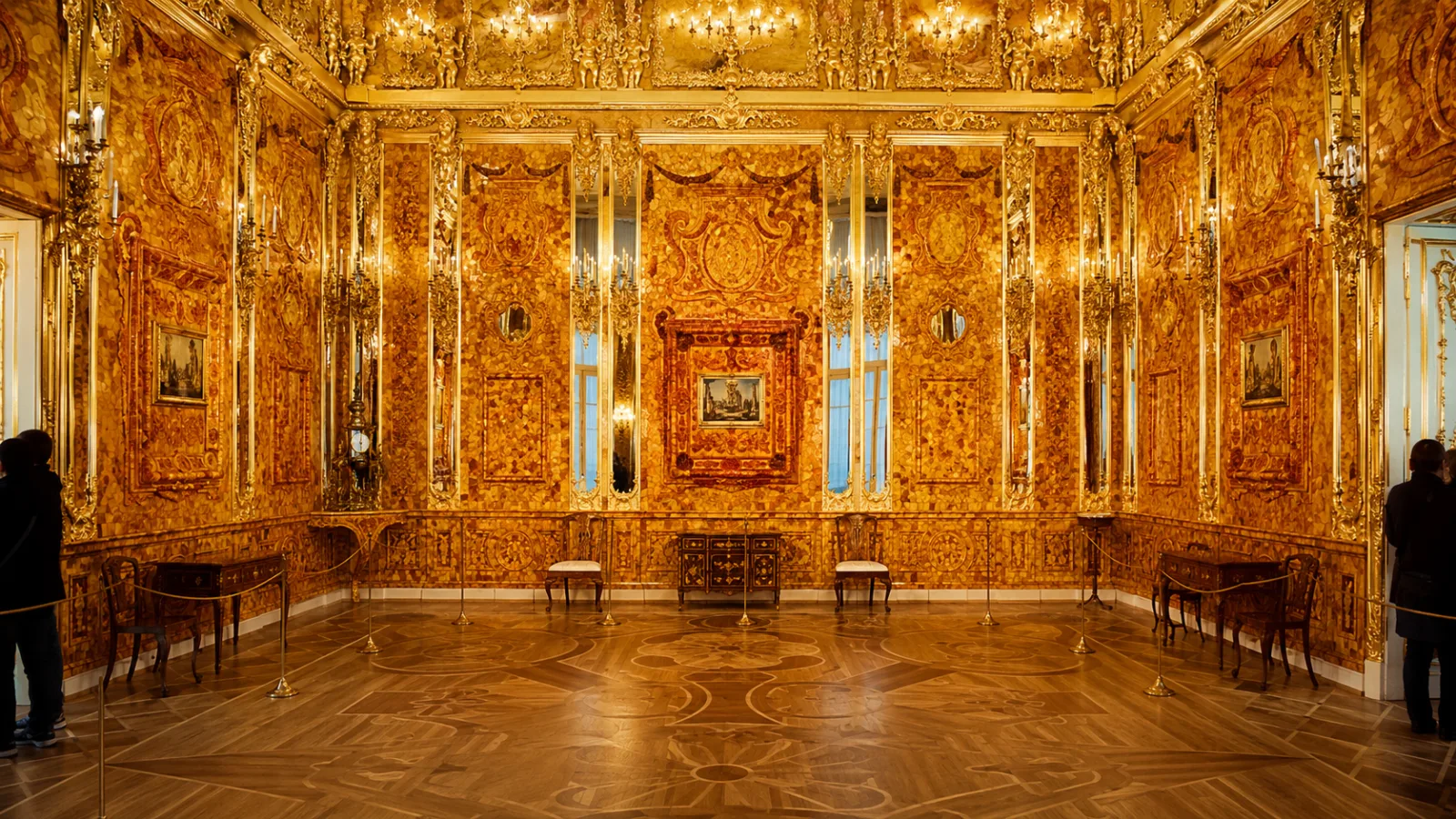
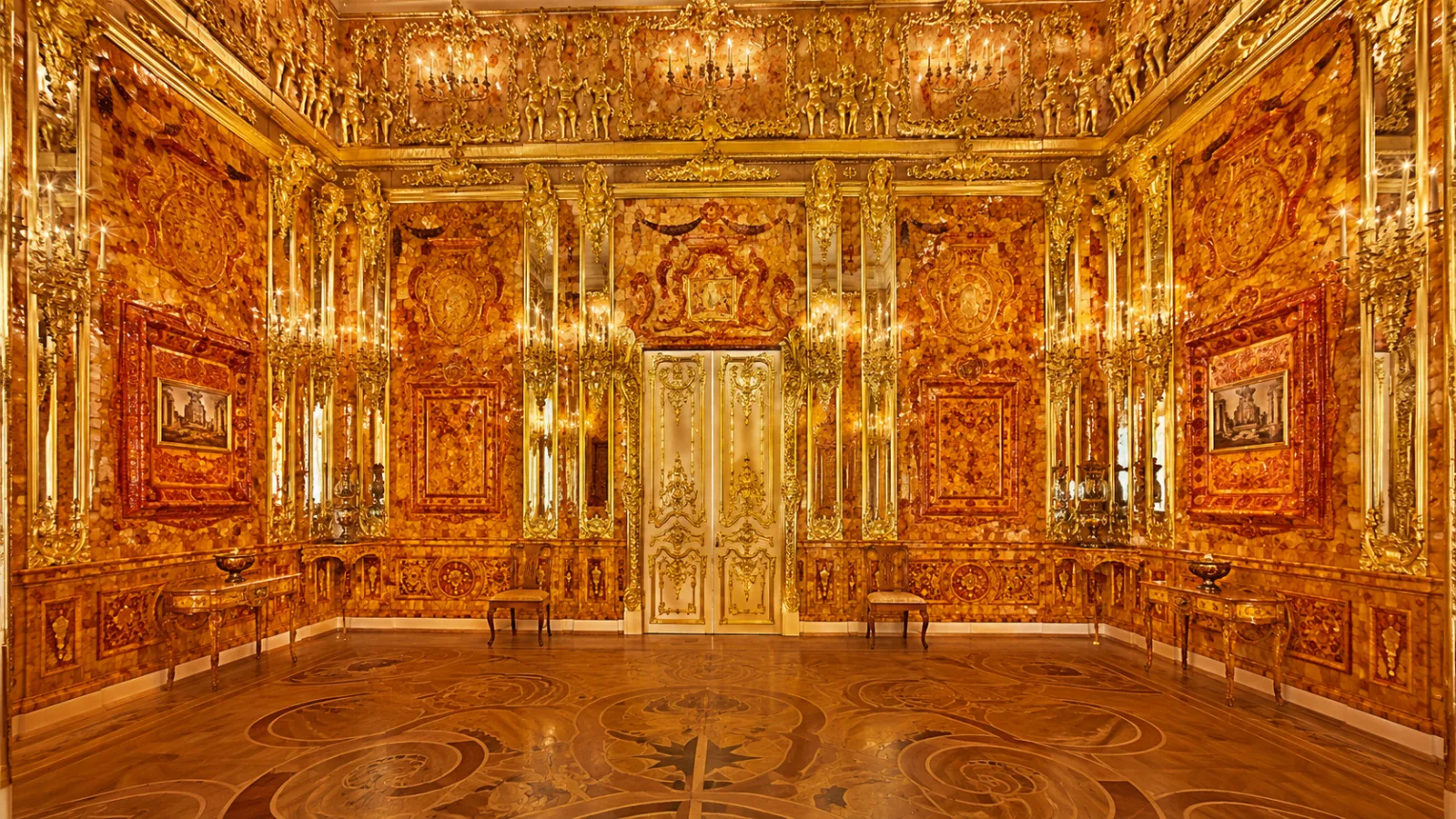
To understand what was lost, you have to go back to 1701, to the court of Frederick the First of Prussia. Amber, the fossilized tree resin gathered along the Baltic coast for thousands of years, was already prized across Europe, sometimes called the gold of the north. Frederick commissioned a chamber built entirely from it. Master craftsman Andreas Schlüter designed it, and artisans led by Gottfried Wolfram spent years fitting together small pieces of amber like a puzzle, backing them with gold and mirrors so the whole room would seem to glow from within.
The room never quite found a permanent home in Prussia. In 1716, King Frederick William the First gave it as a diplomatic gift to Tsar Peter the Great of Russia, sealing an alliance between the two powers. The panels were shipped to Saint Petersburg, where they sat in storage for decades before Empress Elizabeth had them installed, expanded, and eventually moved into the Catherine Palace at Tsarskoye Selo, just outside the city.
Russian craftsmen added more amber, more gold, more mirrored panels, until the room stretched across roughly 180 square feet, glowing under candlelight in shades of honey, rust, and burnt orange. Contemporaries described stepping inside as something close to standing inside a jewel. For over two hundred years, it remained one of the treasures of the Russian court.
War Reaches Tsarskoye Selo
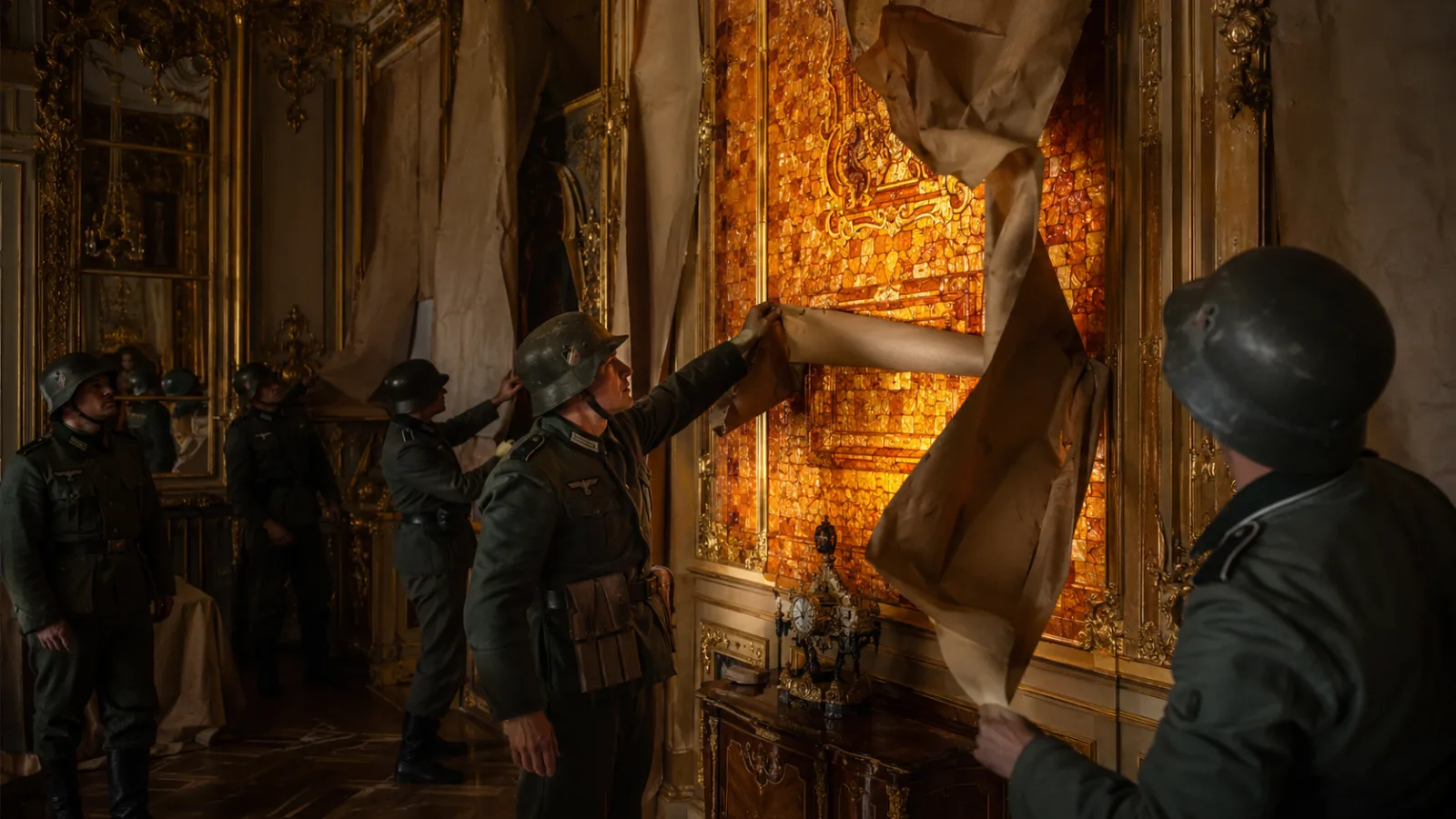
When Nazi Germany invaded the Soviet Union in June 1941, the advance toward Leningrad brought German forces perilously close to Tsarskoye Selo. Soviet curators tried to save the room, attempting to disassemble the delicate amber panels for evacuation. But the material had grown brittle over two centuries and began to crumble at the touch. With German troops closing in, the curators made a desperate decision: they papered over the amber panels, hoping to disguise the room as an ordinary space and hide it in plain sight.
It did not work. German soldiers, some of whom apparently knew exactly what they were looking for, found the room within days of occupying the palace in September 1941. Under the direction of two German officers with backgrounds in art history, the panels were carefully removed, packed into crates, and shipped by rail to Königsberg, then a German city on the Baltic coast, now the Russian exclave of Kaliningrad. There, the Amber Room was reassembled and put on public display inside Königsberg Castle. For a time, the Nazis seem to have treated it as a rightful reclamation—a treasure of Germanic and Prussian origin returned to German soil.
The Final Move—and the Trail Goes Cold
That display lasted a little over two years. By the autumn of 1944, the war had turned decisively against Germany. Allied bombing raids struck Königsberg that August, and the museum director in charge of the room, Alfred Rohde, reportedly began packing the panels into crates again, this time to move them out of the city ahead of the advancing Red Army. This is where the documented trail begins to blur.
What we know for certain is that Soviet forces captured Königsberg in April 1945 after brutal, block-by-block fighting that left much of the city in ruins. Castle remains were searched. Soviet investigators questioned Alfred Rohde repeatedly in the months that followed. Then, in December 1945, Rohde and his wife died suddenly, officially attributed to typhus, just before a scheduled follow-up interview with Soviet authorities. Some researchers have questioned the timing, though no conclusive evidence of foul play has ever been produced. The coincidence has fueled speculation for decades.
The Amber Room itself was never found in the castle ruins. No crates. No panels. No trace.
Three Theories, No Proof
From there, the theories branch out—and it's worth walking through them honestly, because none has ever been proven.
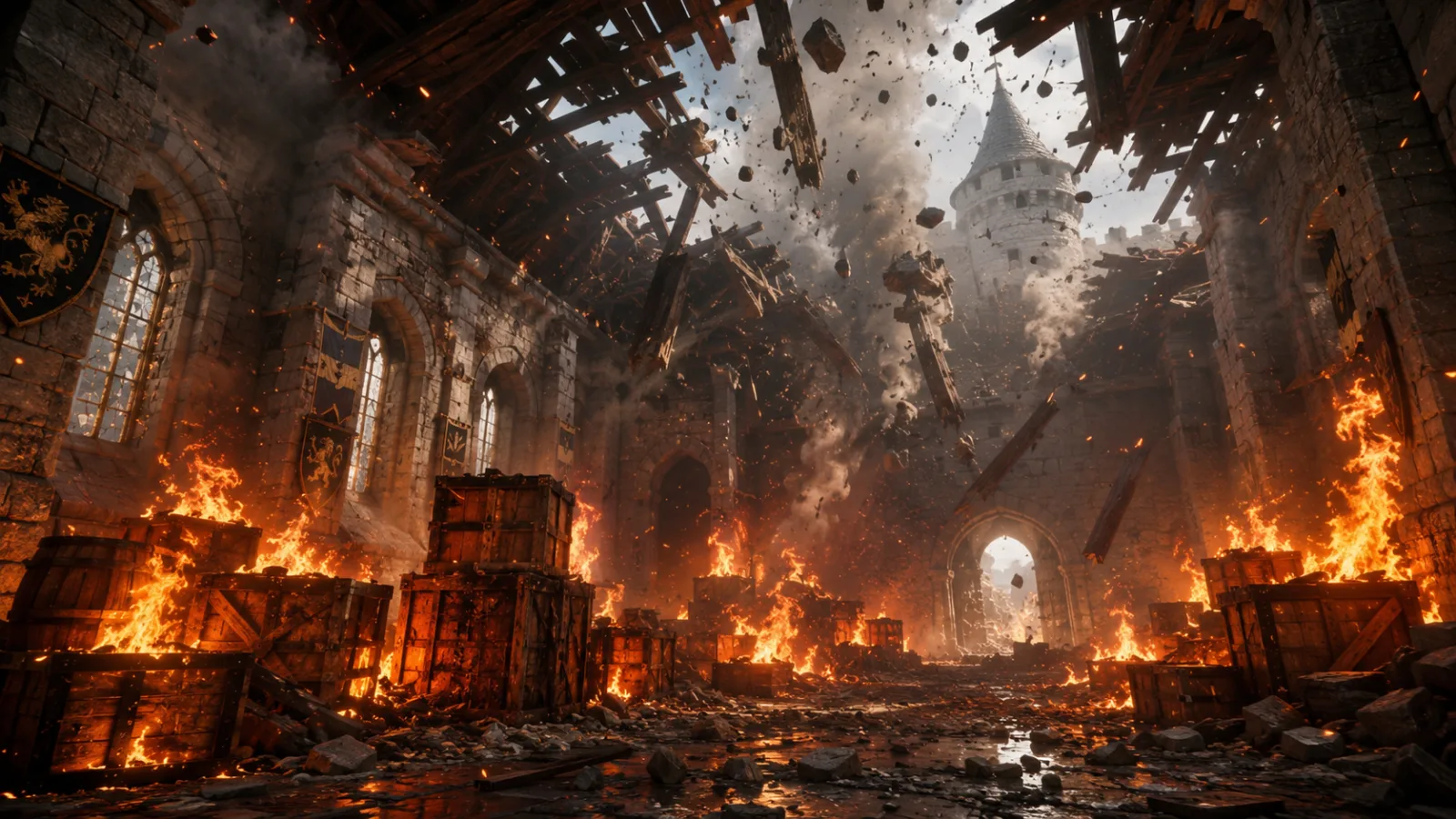
The most straightforward theory is also the bleakest: the room was destroyed. Königsberg Castle burned during the Soviet assault and the subsequent occupation, and some historians argue the amber panels, packed in wooden crates inside a structure engulfed in fire, simply turned to ash and melted resin. Amber is flammable and fragile. A sufficiently intense fire could have erased it entirely, leaving nothing identifiable behind. This theory doesn't require a conspiracy—only the ordinary brutality of war.
A second theory holds that the crates were loaded onto a ship evacuating German personnel and refugees from East Prussia in early 1945, and that the vessel was subsequently sunk. Several ships were indeed lost in the Baltic during that chaotic evacuation, most infamously the Wilhelm Gustloff, sunk by a Soviet submarine with catastrophic loss of life. Some researchers have proposed the Amber Room was aboard one of these vessels, resting somewhere on the floor of the Baltic Sea. No wreck search has ever produced confirmed remains of the room.
A third theory, favored by generations of treasure hunters, holds that the crates were hidden somewhere on land before the final Soviet assault—tucked into a mine, a bunker, or a cellar in the region around Kaliningrad or further inland—and that the hiding place was never recorded, or the person who knew was killed before the war's end. This theory has driven dozens of organized searches. Expeditions have dug into abandoned mines in Poland and Germany, drained ponds, and searched sealed bunkers, chasing leads based on wartime documents, deathbed confessions, and local legend. None has produced the Amber Room. Some have found nothing at all; others have found unrelated wartime debris, mistaken by hopeful searchers for confirmation.
Fragments That Did Survive
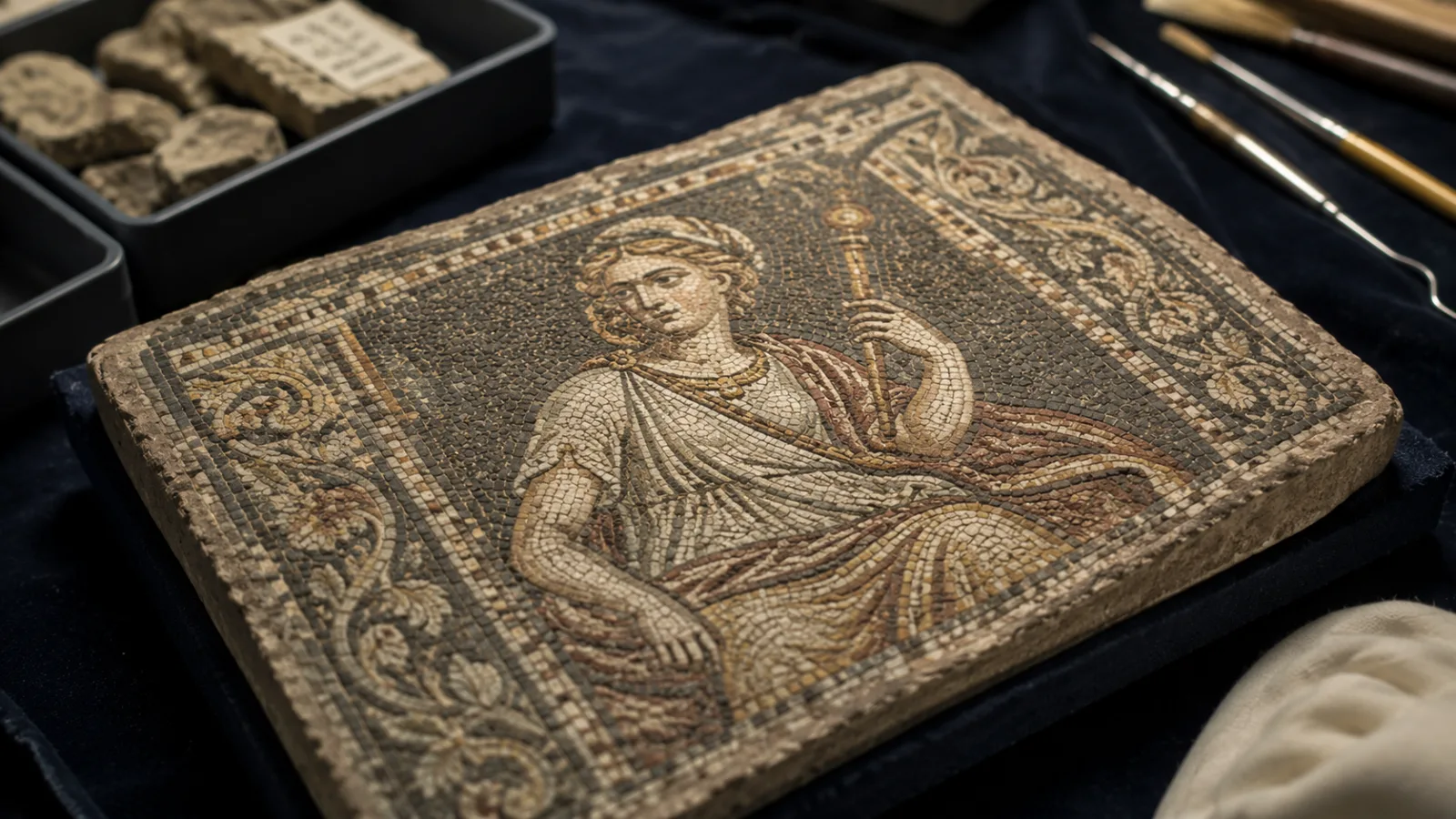
Adding to the intrigue, a few fragments have surfaced that are genuinely tied to the room. In the 1990s, a mosaic panel depicting an allegorical scene, one of four such panels known to have been part of the room's decoration, turned up in Germany in the possession of the family of a soldier who had reportedly taken it as a war trophy. It was authenticated and returned to Russia. A chest believed to have been part of the room's furnishings has also surfaced.
These fragments prove the room was disassembled and that at least some pieces survived the war in private hands. They do not tell us what happened to the rest.
Rebuilding What Was Lost
Faced with the possibility that the original might never be recovered, Russian authorities made a different kind of decision. Beginning in the 1970s and continuing for decades, using historical photographs, archival descriptions, and surviving craftsmanship techniques, Russian and German artisans undertook a painstaking reconstruction of the Amber Room from scratch. The project took roughly twenty-four years and was funded partly by German corporate donations—a quiet act of historical reconciliation. It was completed and unveiled at the Catherine Palace in 2003, in time for the three hundredth anniversary of Saint Petersburg's founding.
Visitors today can stand inside a room that looks, by all accounts, remarkably close to the original, built using much the same amber-working techniques as the Prussian and Russian craftsmen who came before.
But a faithful reconstruction is not the same as recovery. And that distinction is exactly why the mystery persists.
Why the Case Stays Open
Consider what makes this case so stubbornly unresolved. Unlike many lost treasures, the Amber Room's disappearance happened within living memory, documented by Nazi propaganda photographs, Soviet intelligence reports, and postwar interrogations. We know almost exactly where it was as late as August 1944. We know the name of the man most responsible for its final move. And still, the trail goes cold in a matter of months, swallowed by the collapse of a city and the chaos of a collapsing regime.
Soviet and later Russian investigators pursued leads for decades, some through official channels, some through independent researchers working alongside declassified archives. German researchers have done the same, chasing wartime records and interviewing aging veterans before that generation passed away entirely. Every serious investigation runs into the same wall: the final months of the war in East Prussia produced an almost complete breakdown of record-keeping, as retreating personnel destroyed documents, died, or simply scattered across a collapsing front. The very chaos that makes the Amber Room's loss plausible is the same chaos that makes it nearly unsolvable.
Destroyed by fire in a burning castle. Lost at the bottom of the Baltic Sea, sealed inside a sunken hull. Hidden in a forgotten cellar or mineshaft, waiting for someone to find the right map, the right rumor, the right hunch. Every theory has its serious defenders. None has physical proof strong enough to close the case.
What's left behind is a room built twice: once by Prussian and Russian craftsmen who could not have imagined the war that would tear their work apart, and once more, generations later, by artisans determined to give the world back something close to what was lost—even if the original amber, the original gold, the original room that Peter the Great and Catherine's court once walked through, remains wherever the last days of Königsberg left it.
The Amber Room stands today as both a monument and a question mark: a masterpiece that history managed to erase almost completely, and a mystery that refuses, even now, to be closed.